Bold investments during crises are crucial for shaping future economic realities.
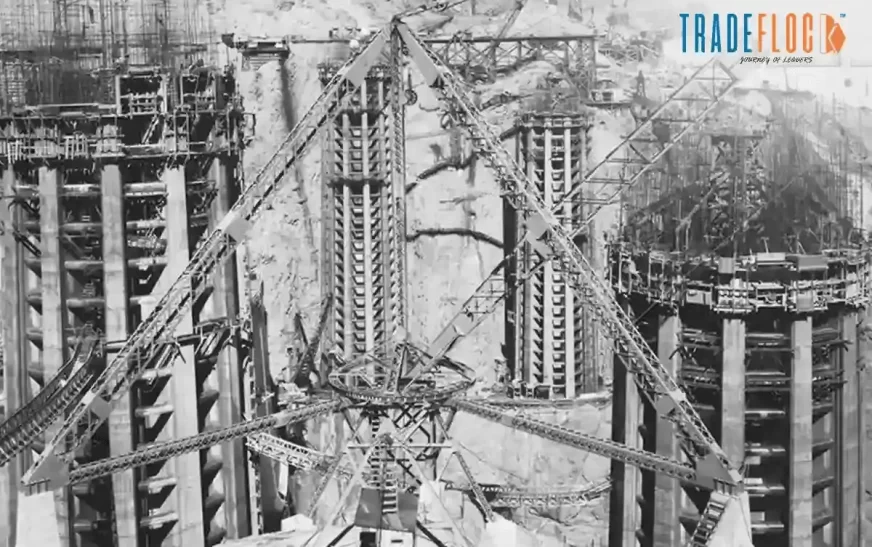
On July 7, 1930, construction officially began on the Hoover Dam, a project so ambitious that many questioned whether it could be completed at all. The United States was entering the darkest years of the Great Depression. Businesses were collapsing, unemployment was rising sharply, and public confidence was deteriorating. Against that backdrop, the federal government approved one of the largest engineering projects in American history.
Over the next five years, more than 21,000 workers would contribute to the dam’s construction. Built across the Colorado River on the border of Nevada and Arizona, the project created a structure standing over 726 feet tall and capable of generating enormous quantities of hydroelectric power. Remarkably, the contractors completed the project nearly two years ahead of schedule and millions of dollars under budget. At the time, newspapers largely covered it as a public works programme, a source of employment, and a remarkable engineering accomplishment.
Built During Uncertainty
What received far less attention was the leadership philosophy embedded within it. The Hoover Dam represented a decision to build during uncertainty rather than wait for certainty. This holds significance because economic crises often produce a powerful temptation toward caution. Governments postpone investments, businesses delay expansion plans, and institutions focus on preservation rather than creation.
People who were behind the Hoover Dam chose a different approach. They treated infrastructure as a confidence-building mechanism. The project was designed to create jobs immediately, yet its real value lay decades into the future. The dam would provide electricity, water management, flood control, and agricultural support across large portions of the American Southwest. Cities such as Las Vegas, Phoenix, and Los Angeles would later benefit from the foundation it helped establish.
Many observers at the time viewed the project through the lens of cost. History ultimately judged it through the lens of capability, and that is what people missed. The Hoover Dam was never only about concrete, steel, or electricity. It demonstrated that large-scale infrastructure could shape economic trajectories and the green economy long after the crisis that justified its construction had faded from memory. The workers pouring concrete in Black Canyon were building an asset that future generations would inherit.
Principles Influencing Today’s Leadership Decisions
Nearly a century later, the same principle continues to influence leadership decisions around the world. Across Asia in 2026, business leaders are operating in an environment defined by geopolitical uncertainty, supply-chain disruptions, technological transformation, and shifting economic alliances.
Yet some of the region’s most influential companies continue investing heavily in infrastructure. Technology firms are building data centres capable of supporting artificial intelligence workloads. Manufacturers are redesigning supply chains to improve resilience. Telecommunications providers are expanding digital connectivity into underserved regions. Governments are investing in semiconductor ecosystems, renewable energy networks, logistics corridors, and advanced transportation systems
The similarities with 1930 are striking. In both periods, leaders faced uncertainty, and critics questioned the scale of investment. The central calculation revolved around whether long-term capability justified short-term expenditure. The lesson of the Hoover Dam is not that every large project succeeds. History offers many examples of expensive infrastructure that failed to deliver expected returns. The lesson is that transformational periods often reward leaders willing to invest before the benefits become obvious.
Growth Has Its Own Pace
Today, when executives discuss digital infrastructure, AI capacity, manufacturing ecosystems, energy resilience, or supply-chain redesign, they are engaging with the same underlying leadership question confronted in 1930: what foundations must be built now to enable growth later?
The workers who arrived in Nevada during the Great Depression could not have predicted the economic transformation that would follow. They were responding to the challenges of their own moment. The infrastructure they built outlived those challenges by decades.
This is the only reason why the Hoover Dam remains more than a historical landmark. It serves as a reminder that leadership is often measured by what gets built during periods of uncertainty. Nearly ninety-five years after construction began, the dam continues to generate power, manage water resources, and support millions of people. The crisis that inspired it belongs to history. The infrastructure still shapes the present. For leaders navigating uncertainty in 2026, that may be the most important lesson of all.