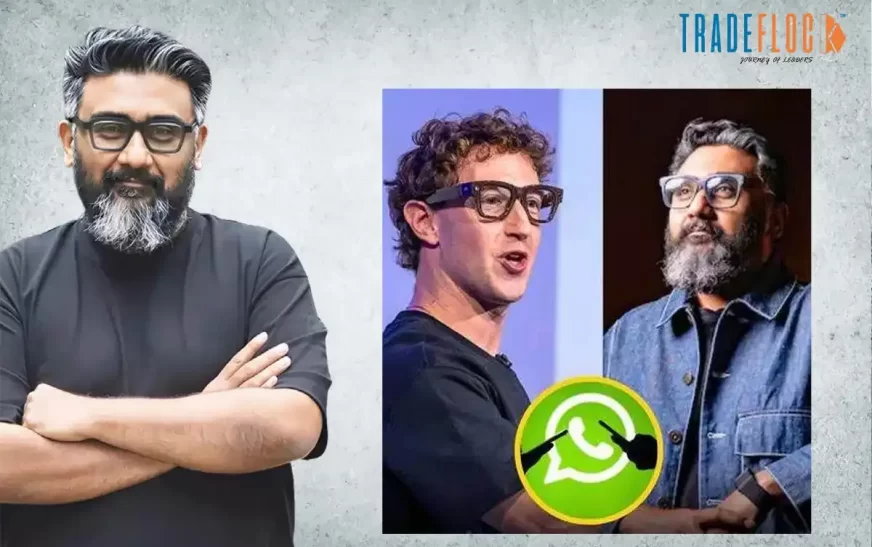
Kunal Shah preferred honing his entrepreneurial skills by doing. He has now accepted a bigger, more far-reaching challenge: making people use WhatsApp beyond texting.
The appointment of Kunal Shah, the founder and CEO of fintech platform CRED, as the Global Head of WhatsApp has broken the usual mould. The typical path for Indian executives into Silicon Valley’s top ranks runs through one of two well-worn routes: a long internal climb or a lateral move plucked from a rival firm in the area.
Kunal, who is joining as part of Meta’s $900 million investment in CRED, has traversed neither of the two routes. Rather, he is an outsider, a serial entrepreneur with a proven record of building and scaling transaction platforms and unparalleled knowledge of emerging markets like India.
The Atypical Entrepreneur
Over the years, Kunal has carved out a distinct identity for himself by not fitting the archetypal Indian tech entrepreneur mould. Kunal does not have a background in either engineering or management, which is the case with most tech entrepreneurs in India. He is a philosophy graduate and has learned the ropes of entrepreneurship by doing, working odd jobs since he was 15.
Early in his entrepreneurial career, Kunal realised that the Indian consumer loved being rewarded for regularly using a service. In 2010, he founded Freecharge with this philosophy, at a time when smartphone usage in India was incipient. Mobile recharges were predominantly an offline activity, more out of necessity than a conscious choice.
Seeing this untapped potential, Kunal floated the idea via Freecharge of making mobile recharges virtually free by offering cashback equal to the recharge amount through branded partnerships. With this idea as the bedrock, he also targeted high customer retention through repeated use of Freecharge for mobile recharges, as the cashback concept stuck with users.
The result? Freecharge became the largest internet platform for mobile top-ups in India, and propelled Kunal into national attention. Freecharge was acquired by Snapdeal for about $400 million in 2015, making it one of the most high-profile exits in the Indian startup space. Post-exit, Kunal spent some time investing in nascent technology firms and advising founders.
Doubling Down On Exclusivity
In 2018, using the same philosophy he had used for Freecharge, Kunal added an extra layer drawn from his reading of Indian society: exclusivity and elusion. India is a country rife with inequality, making exclusivity something that most Indians aspire to.
Consequently, he created a premium, invite-only fintech product that onboarded fewer customers, only those with high credit scores. But targeting the Indian psyche of climbing the socio-economic ladder and proving their superiority to others paid off. CRED processes 40% of credit card bills in India and has also expanded into lending, insurance, and wealth management, as Kunal argues that it is easy to cross-sell products on a platform they trust.
CRED also became a recognisable brand with its inventive and witty marketing, banking on nostalgia and unexpected celebrity appearances. But despite having 17 million users, making $325 million in annual revenue last year, and hitting profitability last quarter, it is still seen by many as a niche business.
A Turnaround Hire?
The biggest question that has emerged is why Meta went out of its way to hire Kunal, of all people! According to Chris Cox, Meta’s Chief Product Officer, who hired Kunal, he was seeking an entrepreneur from a country where WhatsApp already has a strong foothold. India emerged as the obvious choice, with 500 million-plus users and being its largest market by geography.
However, the answer could be more towards how WhatsApp has been unable to evolve beyond a tool for communication. WhatsApp allows users to send and receive money in the app, but it currently accounts for less than 1% of digital transaction volume, data released by the National Payments Corporation of India shows.
Many observers believe that Kunal has been brought on board to address this problem, as he believes that users tend to trust platforms which they use frequently. However, despite WhatsApp’s large user base in India, people’s trust in it is no more than that of a messaging platform.
Scaling WhatsApp to a Super App
Bringing Kunal also alludes to Meta CEO Mark Zuckerberg’s desire to create a ‘super-app’ from the groundwork laid by WhatsApp, imitating China’s WeChat and Alipay. Kunal has echoed this sentiment, claiming that in a low-trust society like India, the concentration of trust could aid the development of super apps.
The brief that is expected to be handed to Kunal at the Meta headquarters is the opposite of what he has done so far in CRED: instead of rewarding the top 1% of India for using its services, make hundreds of millions of users in the middle of the pyramid feel rewarded for using a digital utility for daily needs. While owning a successful super-app in India remains elusive, if anyone can pull it off, it will be Kunal.