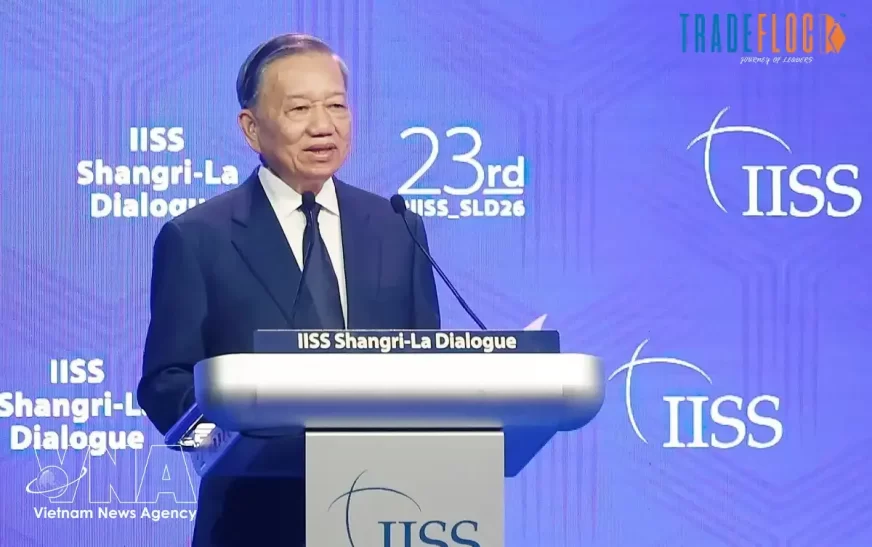
To Lam, President of Vietnam, said that countries in the Asia-Pacific region are seeking “responsible commitment” from global powers amid escalating geopolitical tensions. Lam delivered the statement while addressing the Shangri-La Dialogue in Singapore, adding that stability in the region will be determined by transparency, international law, and restraint by global powers vying for dominance. Lam added that the region wants responsible engagement from global powers rather than their presence or absence, to ensure regional peace, prosperity, and collaboration. Lam cautioned that strategic competition between global powers must adhere to international rules and not escalate into confrontation.
To Lam urged international assistance for Vietnam’s growing economy, particularly for implementing its “One Destination” initiative, aimed at fostering greater harmony among the seven countries and contributing to the development of the 10% of Vietnam’s workforce employed in the creative economy. He believes a new diplomatic approach is necessary to achieve these goals because many current international institutions and agreements are either not functioning or do not adequately address the needs of the host nation, the visitors, or both. Furthermore, To Lam hopes that new diplomatic relationships between the United States and Vietnam will help promote economic cooperation and development by providing both nations with greater access to scientific, technical, and cultural knowledge.
Read More: Toyota Motor to Launch Taiwan-Made Vehicles in Japan
These comments have come against the backdrop of growing tensions over China, Taiwan, the South China Sea, and the wider US-China rivalry, which are shaping the security agenda in Asia. Vietnam has remained diplomatic, seeking to build stronger relations with several international powers without aligning itself with any specific grouping. This comment also underscores that many countries in the region remain concerned about the security situation, economic stability, and supply chain stability. Analysts suggest that countries in the region are concentrating more on striking a strategic balance.