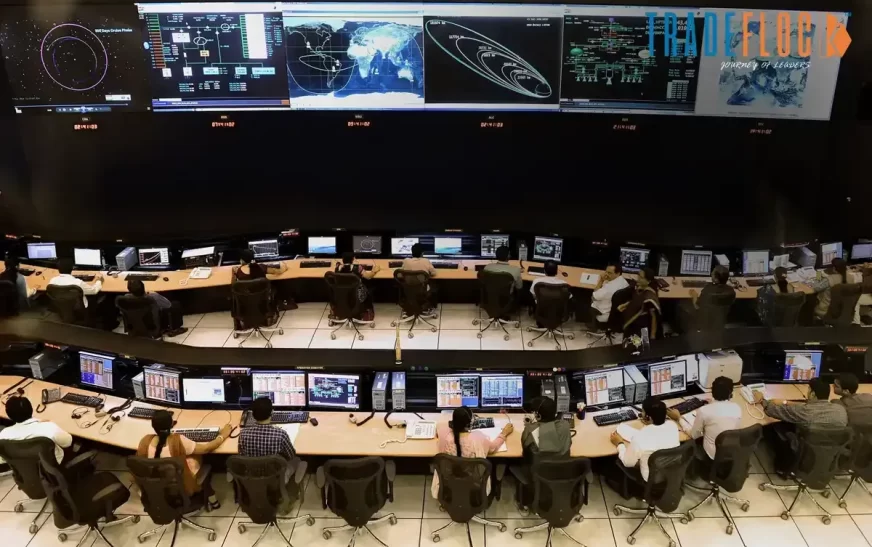
On September 24, 2014, the Indian Space Research Organisation fired the main engine of its Mars Orbiter Mission and let the planet’s gravity capture the spacecraft. The manoeuvre worked on the first try. India became the fourth space agency to successfully place a spacecraft in Martian orbit, after the Soviet Union, the United States, and the European Space Agency. ISRO continues to describe India as the only country to achieve total success on its first Mars attempt.
The spacecraft, named Mangalyaan, was launched nearly a year earlier on November 5, 2013, aboard a Polar Satellite Launch Vehicle from Sriharikota. It spent roughly 300 days in transit before entering orbit, carrying five scientific instruments and a mission budget of about Rs 450 crore, close to $74 million at the time. Prime Minister Narendra Modi, addressing the ISRO team that morning, called the achievement proof that India had “dared to reach out into the unknown.”
Scepticism Before Success
The mission had not been treated as a certainty in the months leading up to it. International commentary in 2014 questioned whether a developing economy with a modest space budget could pull off a manoeuvre that had defeated better-funded programmes on their first tries. ISRO officials pushed back publicly in the days before the burn, insisting the trajectory calculations and system checks had all come back normal. Scientific secretary V. Koteswara Rao told reporters that confidence within the organisation was high and every parameter measured so far was within range. The scepticism made the eventual outcome more striking, and it also meant the achievement had to compete with its own underdog narrative for attention.
Cost Line Everyone Repeated
Most coverage settled quickly into a single comparison: the mission cost less than the reported production budget of the film Gravity. The line was accurate, and it became the story. That framing missed the engineering discipline the low budget actually demanded. ISRO could not afford redundant systems or repeated test attempts the way better-funded agencies could. Every subsystem had to work close to the first time, on a spacecraft built largely from components and processes the organisation already understood.
The constraint, treated as a punchline in 2014, became the template ISRO would rely on for the next decade. The emphasis on cost-conscious engineering would remain visible in India’s later space programme, including the Chandrayaan-3 lunar mission. The habit of treating cost discipline as an engineering virtue rather than a limitation traces directly back to the choices made on Mangalyaan.
What the Achievement Also Obscured
The “maiden attempt” headline flattened a more complicated history. ISRO had been building interplanetary capability for years before Mangalyaan through its satellite and launch vehicle programmes, and the mission succeeded because of that accumulated groundwork rather than in spite of a lack of it. Framing the orbit insertion as a sudden leap made for a cleaner story. It also obscured the years of launch-vehicle development, spacecraft engineering, navigation and mission operations that made the ‘first attempt’ possible.
A Programme Still Compounding
Mangalyaan operated for nearly seven and a half years before ISRO lost contact with it in 2022, well beyond its original six-month mandate. That extended run gave engineers operational experience with deep space communication and spacecraft ageing that fed directly into later missions. ISRO’s current roadmap reflects the same lineage. The agency has an uncrewed Gaganyaan test flight targeted for the final quarter of 2026, a step toward independently sending Indian astronauts into orbit. The Venus mission will build on India’s accumulated experience in interplanetary mission design, while introducing new challenges such as aerobraking and thermal management. Meanwhile, India’s private space sector has expanded, with companies such as Skyroot Aerospace developing commercial launch capabilities.
None of these programmes exists because of Mangalyaan alone. They exist because Mangalyaan converted a question mark over India’s technical seriousness into a settled fact, and every mission since has been built on the assumption that the fact holds.
The Real Legacy
Twelve years on, the number that mattered most from September 24, 2014, was never the one printed beside the mission’s budget. It was the one printed beside its odds. ISRO had never before reached another planet, and it did not need a second try to do it. That single data point rewrote how the agency planned every mission that followed, from lunar landings to the crewed flights now on the calendar, and it is the reason India’s space programme still moves like an organisation that expects to succeed on the first attempt.