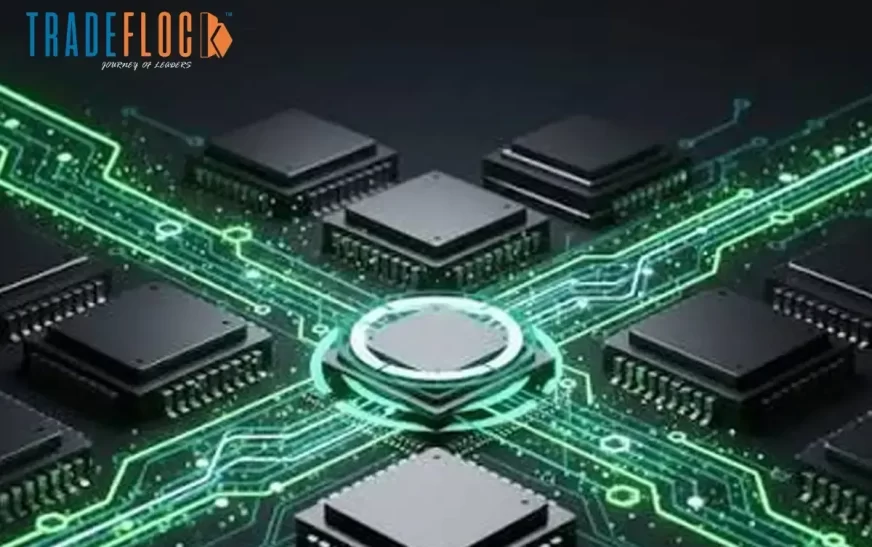
As AI models grow larger and more widely deployed, the cost of running them after training is becoming a bigger infrastructure challenge. Etched, a San Jose-based semiconductor startup, has built its entire identity around that single bottleneck. Rather than competing with Nvidia across every stage of machine learning, the company designs processors built exclusively for inference, the phase where a trained model actually generates an answer.
The AI industry has spent the past three years chasing larger training runs. Nvidia holds approximately 80 to 85% of data centre AI accelerator revenue, according to market analysis published by Presence AI in May 2026. Etched is positioning itself to take a share of that market by refusing to build a general-purpose chip at all.
Hardwiring the Architecture
Etched was founded in 2022 by Harvard dropouts Gavin Uberti, Chris Zhu, and Robert Wachen. The founders bet against the industry consensus that general-purpose GPUs would keep winning. Rather than designing a flexible accelerator that can support many kinds of workloads, Etched has built silicon optimised around the computational patterns of transformer-based models. The resulting product, Sohu, trades flexibility for speed on the workloads it was built to run.
The company’s newer systems, described as full frontier inference clusters, include a low-voltage prefill chip alongside new memory and interconnect technology built for the decode stage of inference. Co-founder and chief operating officer Robert Wachen described the approach plainly. “Inference is built in two stages,” Wachen said, “prefill and decode.” He told reporters the architecture connects many chips to a shared memory pool with low latency, offering higher speeds and lower costs than conventional GPU clusters.
An Unusually Steep Climb
Etched kept all of this under wraps for years before making any of it public. On June 30, 2026, the company emerged from stealth mode with an operational chip and over $1 billion in signed customer contracts. It closed a Series C of $300 million led by Sequoia, Andreessen Horowitz, SK Hynix, Jane Street and Diffusion Capital on July 23 at a valuation of $10.3 billion — roughly double its valuation of $5 billion it secured in December 2025.
The pace accelerated again within weeks. On August 18, Etched announced $700 million in new funding led by Jane Street, with participation from Kleiner Perkins, Sequoia, Andreessen Horowitz, Tiger Global, Bain Capital Ventures, Neo, Primary, Stripes, Positive Sum, and Blackstone, at a $21 billion valuation, bringing the total fund raised to $1.9billion. Kleiner Perkins managing partner Mamoon Hamid, whose firm also backs Anthropic and Databricks, characterised it as a unit economics opportunity.”We will score winners by tokens per dollar and per watt,” said Hilf.
Proof Over Promises
What makes this round different from a regular hardware bet is that this time, the customer, Jane Street, was known in advance. The firm first tested the chip last month and started putting it to use for its own trading algorithms even before it decided to invest. And its disclosure statement was far from equivocal about the reason for its investment: “We tested the chip and are pleased with the early results,” the firm wrote. “Etched’s unique approach to inference delivers the precision we will need to support our most demanding workloads.”
By evaluating the product prior to purchasing and then investing in the company that built it, Etched has something most chip startups don’t: a paying client known for demanding high-precision performance who has publicly spoken out in favor of the silicon.
What Comes Next
Etched has moved from a narrow bet on transformer-only chips to a broader claim. The company says its newer systems are designed to run the latest generation of frontier AI infrastructure models, a shift from the company’s earlier plan to build chips tied to a single architecture. Manufacturing continues through TSMC, and the company says it has already produced working silicon rather than relying on projections alone.
Etched still has to convert its contracts into deployed, revenue-generating clusters for customers outside its own investor base, a test that has undone hardware startups with far quieter valuation curves. The gap between a $21 billion price tag and one confirmed customer deployment remains real. The next test is commercial scale: whether Etched can turn early customer validation and signed contracts into multiple production deployments and recurring revenue.
At a Glance
Founded: 2022
Founders: Gavin Uberti, Chris Zhu, Robert Wachen
Headquarters: San Jose, California
Industry: AI Inference Semiconductors
Valuation: $21 billion