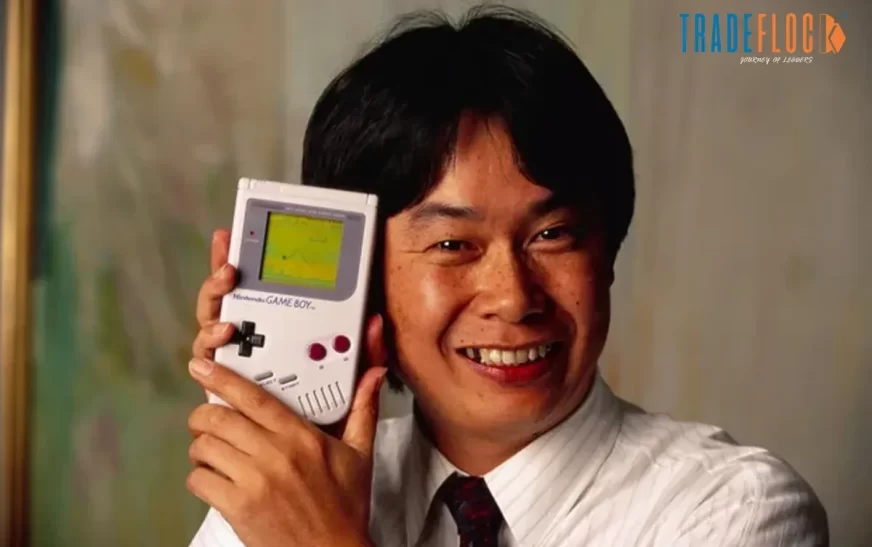
Could anyone in the 80s have imagined travelling around with a gaming console in their pocket? Back then, Tokyo commuters started carrying around a small grey rectangle that would go on to completely change gaming and consumer electronics forever. When Nintendo launched the Game Boy in Japan, it wasn’t just another new gadget — it sparked an entire movement, turning video games from a simple pastime into something people did everywhere, every day.
Before this, gaming was mostly stuck to TVs and power outlets. There had been attempts at portable gaming before, but they were usually held back by weak battery life and basic games. The Game Boy broke that pattern. It wasn’t the most powerful or flashy handheld out there — but it set a whole new standard anyway.
Built to Last, Not Just to Impress
In the late 1980s, competitors like the Atari Lynx were pushing fancy features — colour screens, advanced graphics — but they burned through batteries fast and cost a lot. Nintendo took a completely different approach, thanks to designer Gunpei Yokoi’s philosophy of using simple, proven technology in smart new ways. The Game Boy ran on an 8-bit processor with a basic black-and-white screen, but it ran on four AA batteries for up to 30 hours — way longer than its competitors.
It was also affordable, priced at 12,500 yen at launch in Japan. It was small, tough, and built to survive being tossed around in backpacks and coat pockets. That simplicity turned out to be its biggest strength. Instead of chasing the latest tech trends, Nintendo focused on making something people could actually rely on.
Under the hood, it wasn’t very powerful even by 1989 standards — it ran on a custom Sharp processor at just around 4.19 MHz. But that limitation actually worked in its favour — it pushed developers to focus on making games that were genuinely fun to play, rather than just flashy to look at. That decision shaped everything about how the Game Boy was received, both culturally and commercially.
Tetris: The Perfect Match
When the Game Boy launched in Japan, it came bundled with a few games — but one of them quickly became inseparable from the console itself: Tetris. Created by Soviet programmer Alexey Pajitnov back in 1984, Tetris was already hugely popular around the world. It turned out to be the perfect portable game, and outside Japan, it came packaged with almost every Game Boy sold.
Also Read: Will My Alarm Go Off On DND or When Phone is Silent?
Tetris was simple to learn but endlessly replayable, and that made it appeal to way more than just kids or arcade fans — office workers, students, even grandparents got hooked. In Japan, demand exploded almost instantly — Nintendo sold around 300,000 units in just two weeks. When it launched in North America in July 1989, stores sold out immediately, with about 40,000 units selling in New York City alone on day one.
A Global Phenomenon — By the Numbers
Over its full lifespan — which later included the Game Boy Color in 1998 — Nintendo sold roughly 118.7 million units worldwide. That makes the Game Boy one of the best-selling gaming consoles ever made, rivalled by only a handful of consoles like the Nintendo DS and Sony’s PlayStation 2.
By the mid-1990s, the Game Boy had become a household name in portable gaming. Then came Pokémon Red and Blue in 1996, which gave the platform a massive second wind — selling over 31 million copies worldwide. Another big innovation was the Game Boy Link Cable, which let two devices connect for multiplayer play — laying the early groundwork for the connected, social gaming experiences we take for granted today.
Changing More Than Just Gaming
The Game Boy’s influence went beyond gaming — it proved that portability and quality didn’t have to be a trade-off. Its focus on battery efficiency even hinted at concerns that would later shape mobile phones and other handheld devices.
Economically, it helped cement Nintendo’s dominance after the video game industry crash of 1983. By 1990, Nintendo was leading the U.S. home console market, and the Game Boy played a big role in strengthening that position worldwide. A lot of experts see it as a textbook example of great product-market fit — proof that keeping things simple, paired with a strong lineup of games, can beat out flashier, more “advanced” competitors.
Culturally, it changed how people saw gaming altogether. Suddenly, seeing someone playing games on their commute — in trains, parks, public spaces — became a totally normal sight, both in Japan and around the world.
A Legacy That Still Fits in Your Pocket
Looking back at its launch in April 1989, it’s kind of remarkable how low-key it actually was. No big flashy claims, no cutting-edge graphics — just a simple, durable device built to be genuinely useful.
The Game Boy’s influence can still be seen in every handheld console that came after it — the Nintendo DS, the Switch, and beyond. In a way, it even predicted the smartphone era, where games would once again end up living in everyone’s pocket.
When Nintendo launched the Game Boy, it wasn’t just releasing another gadget — it completely reshaped how and where people played games, freeing it from the living room for good. And it proved something simple but powerful: sometimes, the smartest move isn’t adding more features — it’s making what already works even better. The future of gaming became portable in 1989, and honestly, it never really went back.