The unresolved challenge in the rapidly evolving fields of artificial intelligence and human-machine interfaces is creating systems that enable humans to communicate directly with computers in a manner that is quick, intuitive, and accessible to all. Currently, the reliance on screens, keyboards, and voice commands introduces a disconnect between thought and action. For individuals with paralysis or limited mobility, conventional interfaces can be disabling. Even for those with full mobility, these methods are never as fast or subtle as our own thoughts. Merge Labs, a pioneering company expected to emerge in 2026, is aiming to address this fundamental issue. They are developing high-bandwidth, non-invasive brain-computer interfaces (BCIs) that have the potential to revolutionise how people interact with AI and digital systems.
Redefining Brain-AI Integration
At the core of this, Merge Labs‘ mission is bold and highly disruptive, aiming to integrate biological and artificial intelligence to enhance human ability, agency, and experience. Instead of incremental product improvements, the company is pursuing radically new technological paths for BCIs, combining biology, hardware, and advanced AI into systems capable of reading and responding to brain activity at much higher bandwidths than currently possible.
Merge Labs’ foundational idea is that cognition, intention, and digital interaction should directly result from brain states. This is pursued by exploring alternative non-invasive communication methods, such as ultrasound and molecular interfaces, to replace traditional electrodes embedded deep within brain tissue. By avoiding surgical implants, Merge is also optimistic that next-generation BCIs can become more affordable, safer, and accessible to a broader range of users, whether as medical assistive devices or, someday, as consumer products.
A Star-Studded Backing Signals High Stakes in Neurotech
Merge Labs launched in early 2026 with a $252 million seed funding round, signalling strong potential to investors and partners. OpenAI was the first investor, providing significant funding and collaboration on AI models. Other investors include Bain Capital, Gabe Newell, Interface Fund, and Fifty Years. The round valued the company at about $850 million, reflecting high ambitions and investor confidence.
OpenAI’s involvement highlights BCIs as a new frontier for natural communication and interaction with AI. Merge aims to leverage real-time neural interpretation in AI to advance this goal.
The Innovation Behind the Science
Merge Labs offers more than funding; it introduces a unique technical approach. While most BCI projects, like Neuralink, use implantable electrodes, Merge explores alternatives such as molecular interactions with neurones and deep-penetrating ultrasound to transmit neural signals minimally invasively. These methods may enhance the accuracy and range of neural data without incurring invasive risks.
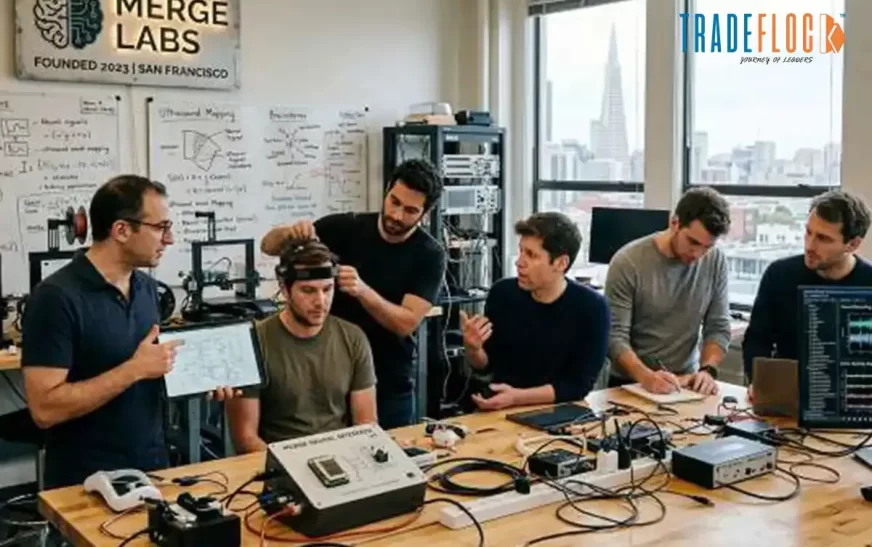
To achieve this, Merge is building a diverse team of neuroscientists, bioengineers, AI experts, and hardware specialists, including pioneers Mikhail Shapiro and founders Tyson Aflalo, Sumner Norman, Alex Blania, and Sandro Herbig, to create a hub for biology, device engineering, and AI innovations.
Human Capability and AI Interaction
Though most BCI research today focuses on therapeutic uses, such as restoring movement in paralysed patients, Merge’s vision goes further. Its founders aim to recover and enhance human abilities, with future applications in communication, learning, creativity, and daily AI interactions. They believe direct brain-to-machine communication can foster human-AI co-evolution. This vision reflects the concept of “the merge”, the deep integration of human and machine intelligence. Merge Labs sees this not as science fiction but as a roadmap for ongoing research.
Competitive Landscape and the Long Road Ahead
Merge Labs enters an industry with some of the most-funded competitors, including Neuralink, which raised $650 million and conducted human tests, as well as other startups developing neural interfaces. Merge’s non-invasive approach, combined with its high level of AI integration, makes it unique and aligns with broader efforts to make BCIs accessible and usable outside medical settings.
Despite its impressive funding and vision, Merge is still in the early stages of research. Turning laboratory discoveries into safe, regulatory-approved products will be a lengthy process due to necessary testing, validation, and collaboration with other scientific and medical communities. However, the large resources invested and the reputation of its investors suggest a serious effort to redefine how humans interact with digital intelligence.
From Lab to the Future of Human Interaction
Merge Labs is on the verge of one of the most disruptive technologies in the history of technology: brain-computer interfaces that could transform human performance and redefine AI interaction. The startup symbolises both the future and the complexity of the neurotech revolution: combining new bio-device engineering with cutting-edge AI systems, backed by hundreds of millions of dollars from the world’s top investors. If successful, Merge may also usher in an era in which thought becomes the next user interface, an advancement that would revolutionise human-machine cooperation.
At a Glance
-
- Founded: 2023
- Founders: Sam Altman, Mikhail Shapiro, Tyson Aflalo, Sumner Norman, Alex Blania, and Sandro Herbig
- Headquarters: San Francisco Bay Area
- Total Funding: $252 million
- Industry: Neurotechnology and Artificial Intelligence
FAQ’s:-
What is Merge Labs?
How is Merge Labs different from Neuralink?
Who is backing Merge Labs financially?
What are the possible uses of Merge Labs' technology?