For fifty years, the Moon has stayed quiet — a silent witness to humanity’s footprints since the Apollo missions in 1972. Since then, the world got wrapped up in itself — smartphones, social media, digital empires. But through all that noise, the Moon just sat there, untouched. Now, that silence is finally breaking.
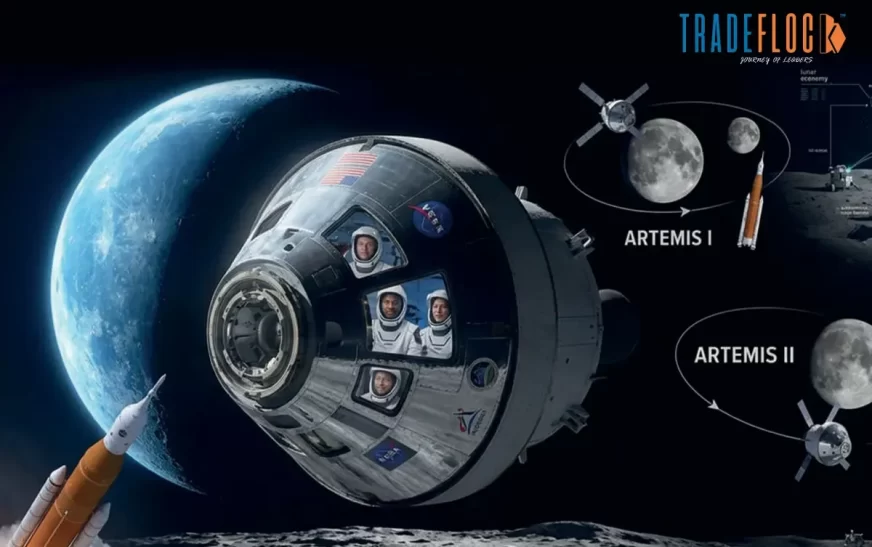
On April 1, 2026, four astronauts will strap into NASA’s most powerful rocket ever built — the Space Launch System (SLS) — ready to launch with 8.8 million pounds of thrust. And unlike missions to the International Space Station, there’s no quick rescue option here — these astronauts are heading beyond Earth’s orbit, all the way around the Moon and back.
This is Artemis II — and it’s more than just another mission. It’s humanity’s big comeback to deep space exploration. Reid Wiseman, Victor Glover, Christina Koch, and Jeremy Hansen will spend ten days flying around the Moon and back — something no one’s done since Apollo. It’s a huge moment. We’re stepping back into the unknown, driven by curiosity and a deep desire to understand our place in the universe. The Moon’s silence is finally breaking — and so is ours.
The Ultimate Test Drive
Artemis II might be the most ambitious and expensive test flight in history. At its centre is the Orion spacecraft — a seriously advanced piece of engineering with a modern glass cockpit, a huge leap from the analogue controls Apollo astronauts used back in the 1960s. But despite all the fancy tech, the mission’s core goal is simple: test everything, break nothing, and bring the crew home safely. Over about 10 days, Artemis II will loop around the Moon and return to Earth — a mission built entirely around precision and purpose.
One really clever design choice is what’s called a “free-return trajectory.” If something goes wrong during the trip out, the spacecraft is built to swing around the Moon and come back to Earth using just gravity — no engines required. Basically, physics itself acts as a built-in backup plan — simple, but genius.
It’s kind of like the ultimate “minimum viable product” — stripped down to the essentials, yet still groundbreaking. Artemis II isn’t just a test flight — it’s a real step forward for human space exploration, blending innovation, caution, and boldness all at once.
A Trillion-Dollar Industry in the Making
Artemis II isn’t just a government project — it’s the opening move in what economists are now calling the “lunar economy,” a whole new industry forming around humanity’s return to space. So far, the Artemis program has already cost over $93 billion, and that investment has fueled some serious technological breakthroughs.
The costs involved are honestly staggering. Just one SLS rocket launch costs around $4 billion, according to Space Policy Online. But there’s a much bigger industry behind the scenes too. Lockheed Martin builds the Orion spacecraft, Boeing and dozens of other suppliers build its components, and European partners contribute key parts like the service module. Companies like Blue Origin are working on multi-billion-dollar contracts to build lunar landers, and thousands of startups are jumping into the space race too — working on things like mining technology, 3D-printed habitats, and autonomous cargo delivery systems.
NASA calls all of this the “Moon-to-Mars” architecture — basically a long-term vision that some business strategists are calling humanity’s “eighth continent.” Why the Moon specifically? Because it has large deposits of water ice, especially near the south pole — and that water can be turned into oxygen and hydrogen, the exact ingredients needed for rocket fuel. In other words, the Moon could eventually become a kind of space gas station for future missions.
Meet the Crew
The Artemis II crew represents a new era of space exploration, bringing together an experienced and diverse group of astronauts. Commander Reid Wiseman is a former Navy test pilot known for his precision and leadership. Pilot Victor Glover already has six months of experience aboard the International Space Station. Mission specialist Christina Koch holds the record for the longest single spaceflight ever completed by a woman. And Jeremy Hansen is making history as the first Canadian to travel to the Moon.
Their journey will take them more than 23,000 miles from Earth — far enough that our planet will look like a small blue marble floating in space. That view completely changed how Apollo astronauts saw the world — it sparked environmental movements, shaped global diplomacy, and shifted how humanity saw its place in the universe.
Now, Artemis II has the chance to bring back that same sense of wonder. This mission isn’t just about national pride — it’s a reminder of what people can accomplish together when they aim for something bigger than themselves.
The “What If” Question
Space travel has always come with real risk, and Artemis II is a clear reminder of that. When the Orion capsule re-enters Earth’s atmosphere, it’ll be moving at around 25,000 miles per hour, generating heat close to that of molten lava. Its heat shield is built to handle that kind of extreme stress — but recent testing has revealed some unexpected wear, which has pushed back the mission’s timeline.
While that might sound like a simple scheduling issue, it’s actually a bigger lesson. A lot of business leaders feel pressure to stick to deadlines no matter what — but NASA is choosing a different approach here, putting safety above everything else. When human lives are on the line, “good enough” just isn’t good enough. Choosing safety over speed isn’t just the right call for space missions — it’s a lesson that applies to leadership in any high-stakes situation. In the end, real progress isn’t just about reaching the destination — it’s about making sure everyone gets there safely.