The economy is often misunderstood. Some people think it’s what a country earns, while some think it’s just a word made up by the Jews to rule the world. The people who believe the latter also think that the world was made last Thursday, so they don’t hold a lot of sway, now do they? The former, though, does have some merit. In short, the economy is the sum of the value of a country’s business infrastructure. There are many types of economies. Capitalist, socialist, and communist. Then come mixed economies. In this blog, we will learn what is mixed economy, and why it’s often called “mixed”.
If you strip away all the jargon and technical talk, a mixed economy is exactly what it sounds like: a mixture of economic ideologies.
Not fully controlled by the governments and not fully left under the market either. Somewhere in between. It’s like trying to keep one foot in each boat. Lean too much towards one, and things start to tip. A mixed economy is all about maintaining the balance.
Let’s Start Simple
In a pure free-market economy, businesses run the show. Think of minimum government involvement as its synonym. Prices, production, wages, most of it is driven by supply and demand. On the flip side, in a command economy, or socialist economy, the government calls the shots. Whether it be the wages, production or prices, the government has the last say.
So, what is mixed economy? It’s an economy that doesn’t go all in on either one. They pick and choose which ideology to apply where.
In a mixed economy, you will see companies competing, innovating and setting prices. But you’ll also see the government stepping in if needs be. Like if they want to build infrastructure, guidelines, and regulating policies. In these economies, the government can also sometimes run key sectors like energy.
Why Mixed Economies Became the Norm?
The world is very different today compared to 70 years ago, when most of these economic systems were emerging. Then the debate was whether capitalism, socialism, or communism was the best. Today, however, the world is not so black and write. It’s a whole spectrum.
If you go all in and leave everything to the markets, gaps start showing up real fast. You see, when everything is left in the hands of big conglomerates, where profit is king, public goods like roads, education, and healthcare are often left unattended. Why? Simply because the public sector isn’t as profitable.
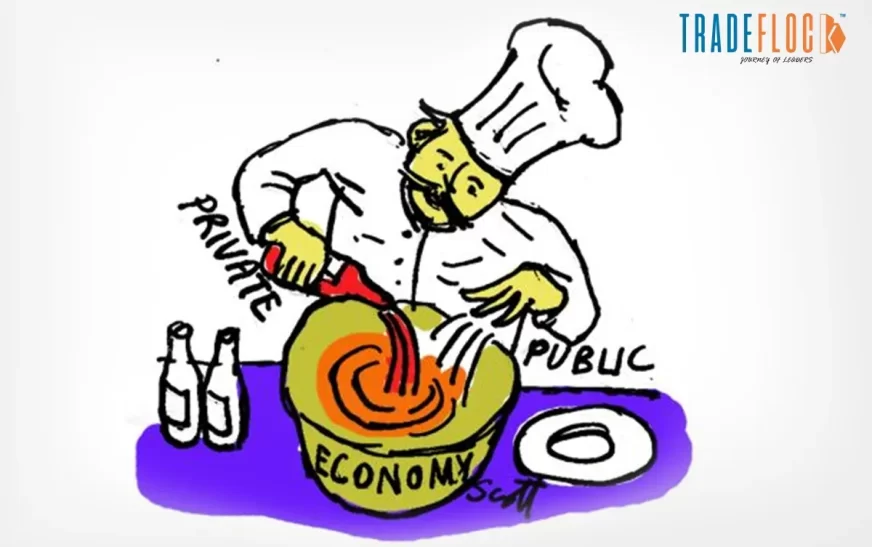
If we look at the other side of the coin, we see that government oversight in everything leads to inefficiencies. Innovation slows down, decisions take longer, and the end goals change with every new government. Sometimes, too many cooks ruin the broth.
As a result, countries started adjusting. Critical sectors like energy, security, agriculture and defence are often under government, while other innovation-heavy sectors are often under private players. This is evident by data from the World Bank, which states that globally, governments account for almost 15 to 20% of GDP through direct spending. This varies from country to country, obviously.
So, next time someone asks you, “What is mixed economy?”, answer them with all the examples and data as well.
What it Looks Like on the Ground
Although top economies like the USA still lean more towards capitalism, mixed economy models aren’t hard to come by. Countries like India are the best examples of how a mixed economy not only helps you grow, but at a phenomenal pace at that.
In India, private companies such as Reliance, Tata, Birla, Adani, and Infosys dominate the technology, retail, manufacturing, and services sectors.
On the other hand, the government is deeply involved in sectors such as Railways, defence, and public infrastructure, including roads, healthcare, and electricity grids. And it’s not like these sectors are small. Not by any means. As a matter of fact, these sectors are among the largest in the world. India has one of the biggest defence infrastructures in the world. Indian Railways alone is the world’s largest employer, with over 1.2 million employees. So, now you know what is mixed economy and how it looks on the ground.
The Balancing Act (Where It Gets Tricky)
Running a mixed economy isn’t just about having both sides present. It’s about knowing when to step in and when to step back.
Too much control, and businesses start struggling under regulations. Too little, and inequality can widen quickly.
For example, Governments often step in to prevent monopolies or protect consumers. In the US, antitrust laws have been used multiple times to break up or regulate dominant companies.
At the same time, overregulation can slow down business activity. So it’s always a bit of a tightrope walk. No perfect formula, just constant adjustment.
The Role of a Government Beyond Control
So, what is mixed economy? It’s an economy where the government can’t just play the regulator role and call it a day. It must play multiple roles. It invests in infrastructure, roads, power, and public transport. Basically, things that corporate or private companies may not build at the same scale as the return is surely lacking. On top of that, it provides subsidies in sectors which are critical, like agriculture and energy, as well as welfare programs, which are often dubbed as freebies. Nevertheless, a government has to provide these things. Especially in developing economies, like most in Asia.
Globally, welfare schemes and subsidies form a significant part of the national expenditure. In many OECD countries, it accounts for as much as 20% of the total government spending. This is a lot, and it’s something a government must do to ensure that the availability of infrastructure is at the same pace as innovation in a country.
The Upside & Downside
So, what is mixed economy’s upsides? Well, it’s all of the things we talked about above. The flexibility it offers is a big part of it. Conglomerates take care of innovation and invention in a region, while the government focuses on core tasks such as building infrastructure.
This is one of the reasons most of the world’s fastest-developing economies have adopted this system. Countries like India, Germany, the UK and the USA all follow a mixed economy in some way, shape or form. And India is also one of the fastest-growing economies in the world.
Now, let’s talk about the downside, shall we? Well, the downsides are simple. In most cases, a mixed economy isn’t as smooth sailing. Sometimes, the end goals of the government and private firms might not coincide, and the public might pay the price.