Making Data, Discipline and Empathy Work Together in Healthcare
Ravindranath Garaga
Group COO
Renova Group of Hospitals
Making Data, Discipline and Empathy Work Together in Healthcare
Ravindranath Garaga
Group COO
Renova Group of Hospitals
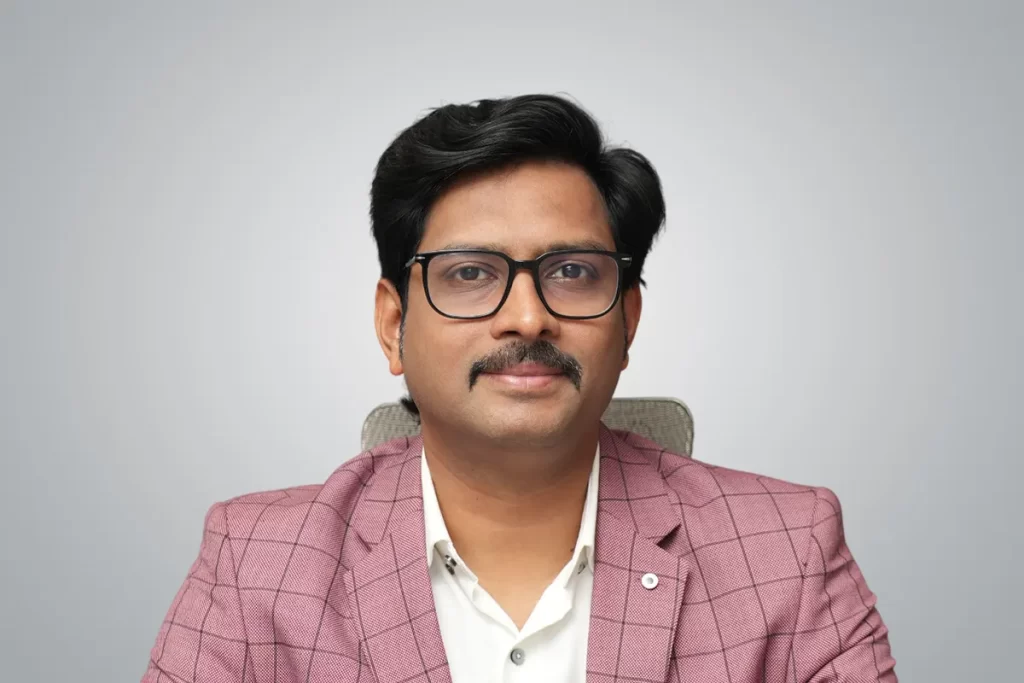
Ravindranth Garaga entered healthcare knowing how to build and run systems at scale. What hospitals taught him was that no system is ever just a system when a patient is at the other end of it. His years at Google and Microsoft gave him a strong grounding in data, automation, process discipline and service-level management. At Renova Group of Hospitals, those principles took on a different weight. A turnaround time can mean a family waiting to take someone home. A diagnostic delay can mean a patient waiting anxiously for an answer.
As Group Chief Operating Officer, Ravindranth oversees a growing multi-speciality network of more than 1,000 beds. His challenge is to build reliable processes at scale without allowing standardisation to make healthcare impersonal. That belief shapes his approach: better systems should remove friction from care and give clinicians more time for patients.
In this conversation with TradeFlock, Ravindranth reflects on his transition from technology to healthcare and the leadership lessons it taught him about empathy, performance and responsibility.
A hospital never operates with a single priority. Patient safety, clinical quality, manpower, doctor engagement, occupancy, revenue, cost management, infrastructure, and patient experience may demand attention simultaneously. Leadership is not about treating all priorities equally but establishing clarity on what requires immediate attention, what can be delegated, and what can wait.
My approach is guided by three filters: patient impact, operational risk, and organisational sustainability. Patient safety and clinical quality come first, followed by issues that could disrupt operations or continuity of care, and then revenue, productivity, cost optimisation, business development, and sustainable growth.
At Renova Group of Hospitals, I use operational and financial dashboards to identify exceptions, emerging risks, and performance gaps, supported by clear KPIs and accountability for second-line leadership.
At the Renovo flagship unit in Banjara Hills, we focused on patient experience, process discipline, cost consciousness, business development, and productivity rather than pursuing multiple priorities simultaneously. This disciplined approach helped the hospital achieve operational break-even within its first year.
I believe the biggest underused opportunity in healthcare is not another hospital application, but the ability to transform fragmented hospital data into an intelligent decision-making system.
My technology career with organisations such as Microsoft and Google gave me experience with structured and unstructured data, data quality, large-scale data acquisition, and information systems. When I transitioned into healthcare, I recognised that hospitals generate enormous amounts of valuable data across HIMS/EHRs, laboratory and radiology, pharmacy, billing, clinical documentation, patient feedback, and operational platforms, but much of it remains fragmented and underutilised.
The real opportunity is to connect these data points and create actionable intelligence. I envision AI systems that proactively identify exceptions, including rising OPD waiting times, capacity constraints, abnormal consumption, declining service-line conversion, follow-up risks, or changing bed availability before they become operational problems.
For me, digital transformation is not about how much technology a hospital purchases. It is about how many better decisions technology enables, how quickly they are made, and how effectively they improve patient care and organisational performance.
I believe affordability, quality, and profitability should not be treated as competing objectives. In a healthcare organisation, they should reinforce one another. Affordability should not compromise quality, and quality should not automatically mean higher cost. The opportunity lies in reducing waste, improving productivity, and using resources while protecting clinical standards.
My experience in hospital P&L management has taught me to remove waste, not value. I have worked on manpower rationalisation, vendor negotiations, process re-engineering, productivity improvement, audits, service-line expansion, occupancy optimisation, and case-mix improvement.
At Medicover Hospitals, audits across stores, pharmacy, and referrals helped identify operational leakages and improve resource utilisation. The distinction is important: reducing patient value is cost cutting; eliminating duplication, leakage, inefficiency, or idle capacity is operational excellence.
As a Group COO, my focus is to protect clinical quality, eliminate waste, improve productivity, and use scale to make healthcare accessible, financially sustainable, and operationally resilient.
One philosophy has remained constant throughout my career: build systems but never forget that people make those systems work. Technology taught me the value of standardisation, measurement, accountability, process discipline, and scale. Healthcare taught me that none of these can succeed without trust.
My two-decade journey has also shown me that meaningful achievements are rarely individual. Mentors, leaders, and teams have shaped every transformation and milestone along the way.
At Renova Group of Hospitals, I have focused on strengthening second-line leadership through clear KPIs, dashboards, accountability, and decision ownership. The objective is to build an organisation that does not depend on one individual but develops leaders who can make informed decisions and deliver outcomes independently.
I believe a COO’s role is to create clarity, empower people, remove barriers, and build accountability. In healthcare, all of this ultimately comes together around one purpose: the patient.