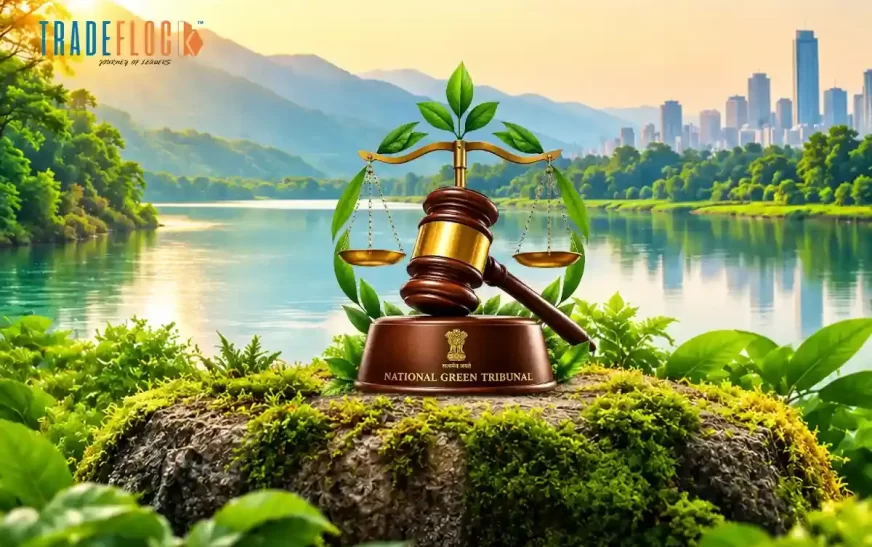
Recently, news came out about a group of people protesting in Uttarakhand, near Dehradun, against a deforestation drive linked to a new road project connecting Dehradun and Rishikesh. Although the government temporarily suspended tree-felling for the project pending further consultations, the incident highlighted. This is nothing new, however even in the past, protests like these have happened. As a result, to ensure the environment is not harmed in the pursuit of better infrastructure, the National Green Tribunal was formed.
This raised an important question: what is NGT, and why does India need a separate body to handle environmental disputes? The answer is the National Green Tribunal (NGT), which was established in 2010 as a specialised forum for resolving environmental cases and providing faster access to environmental justice.
What Is NGT and Why Was It Formed?
The NGT is a special court in India that deals with environmental cases. It was created under the National Green Tribunal Act in 2010 to handle cases that are related to protecting the environment, forests and natural resources.
The main goal of the NGT is to provide quick and fair justice in environmental matters, without any delays that you can often see in normal courts. The Tribunal includes professionals with a strong understanding of science and environmental issues, which helps it make more informed decisions.
Issues That National Green Tribunal Deals With
Once you know what the NGT is and when it was set up, do you know why it was created? Before the NGT, cases pertaining to the environment used to take years to resolve, and usually by the time they were resolved, the damage was already done, rendering the whole proceeding moot.
Environmental Laws Under NGT’s Jurisdiction
The NGT gets its legal power from several important environmental laws in India. These include laws that deal with water pollution, air pollution, environmental protection, forest conservation,and the protection of biological diversity.
Types of Environmental Disputes
National Green Tribunal deals with different kinds of environmental problems, which include pollution, cutting down forests(deforestation), poor waste management and damage caused by industries and development projects. NGT also looks into cases where environmental damage harms people, animals, or nature.
What Are the Powers of NGT?
Do you know that NGT has the power to make sure environmental laws are followed and cases are proceeded with on time, not left in some dark and dusty room till the end?
Providing Relief and Compensation
The NGT can provide compensation to people and communities who suffer because of pollution or environmental damage.
Ordering Environmental Restoration
Not just solving environmental problems but also helping to restore damaged natural areas by planting trees, cleaning up polluted places, and bringing them back to a healthier condition.
Holding Polluters Accountable
The Tribunal finds out who is responsible and takes action against industries, authorities, or individuals who break environmental rules. NGT follows the “Polluter Pays Principle”, which says those who are responsible for causing the damage must bear the cost of the damage.
How Does NGT Help in Delivering Environmental Justice?
One thing you’ll probably like about the NGT is that it actually listens to environmental concerns and helps turn environmental laws into real action. Instead of letting complaints sit for years, as they sometimes can in regular courts, the NGT focuses on resolving environmental issues more directly. And the best part? You don’t have to keep going back and forth just to make your voice heard. NGT makes sure of that from day one.
Here are some famous cases before the NGT that show how it has handled real environmental issues.
In Burari, Delhi, residents had simply had enough. Dust everywhere, damaged roads and sewage overflowing had become a regular problem in their area. So, they took the matter to the NGT. The Tribunal took notice and asked the Delhi government to respond. What made their complaint even stronger was that the Commission for Air Quality Management had already acknowledged in an official circular that road dust is a major contributor to pollution in Delhi-NCR. In other words, the residents weren’t just making claims the government’s own data backed them up.
A similar situation came up in Greater Noida, but this time the issue was groundwater. Builders in Greater Noida and Greater Noida West were accused of illegally extracting groundwater. The NGT stepped in to look into where the water was being taken from and whether the builders should have to pay compensation for the damage caused. The matter is still under consideration, with the Tribunal continuing to examine the issue rather than letting it fade away.
Together, these cases show what the NGT can do for ordinary people. Whether it’s dust-filled roads or groundwater being extracted, residents have a place where their concerns can be heard. More importantly, the NGT can ask authorities and builders to explain what is happening and take responsibility for their actions.
NGT’s Role in Shaping India’s Environmental Future
At the end of the day, keeping our neighbourhoods, rivers, and forests safe isn’t just about government policies. It’s also about giving ordinary people a voice when things go wrong. After understanding what is NGT and the work it does, it honestly feels good to know that India has people who genuinely care about the country and are working to make a real difference. Unlike the usual courts, which can sometimes feel like they’re more focused on money or simply delaying cases, the NGT is actually taking important steps and getting things done. It’s something we can truly be proud of, having a community like the NGT that cares about India and its environment.
But then, why should it be only the NGT? What about us?
We’re also living in India, so don’t we have a responsibility to protect our country too? We don’t always need to do something big. Even the smallest of efforts can make the biggest difference, like conserving water, throwing rubbish in the right places, avoiding unnecessary waste, and keeping our surroundings clean and let’s make it a happy and green economy.
If the NGT is doing its part to protect India’s environment, we can do our part too.