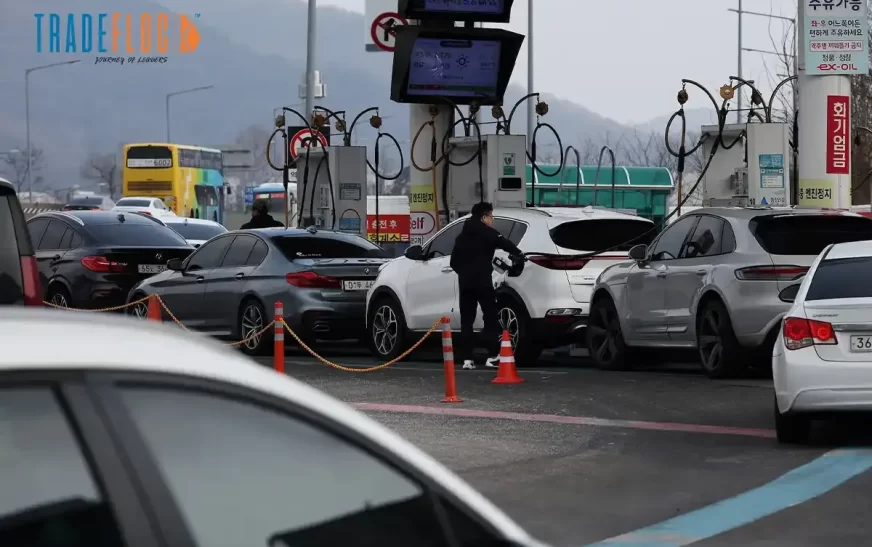
South Korea is ready to implement a fuel price cap for the first time in 30 years, as oil prices rise on Monday due to the war in Iran. President Lee Jae Myung, speaking at the emergency meeting on the impact of the Middle East crises, said the government will “swiftly introduce” a fuel price cap, and Seoul will explore ways to diversify its energy sources.
Brent futures rose 13% to $104.7, while US West Texas crude futures jumped 30% to $118.46 before settling at 13% over the price at $102.4. The 30% jump is the largest jump since 1988.
Lee said, “We must swiftly introduce and boldly implement a maximum price system for petroleum products, which have recently seen excessive price increases.”
Yanhap reported that the average gasoline price in Seoul crossed 1,900 won ($1.28) per litre for the first time in 4 years. On Sunday, it rose to 1,945 won.
The current crisis is a significant burden on South Korea’s economy, which is dependent on global trade and energy imports from the Middle East. He further added that South Korea will also look for a source of energy, supplies shipped via the Strait of Hormuz.
The US President Donald Trump struck a defiant tone on rising prices and said that the ‘short-term oil prices’ were a small price to pay for destroying Iran’s nuclear threat.
Also Read: Vietnam Scraps Fuel Tariffs Amid Iran War Disruptions
The country’s benchmark has seen significant changes over the past weeks; on Wednesday, marketing was its worst day on record, falling 12% before surging 10% and falling again on Friday and Monday.