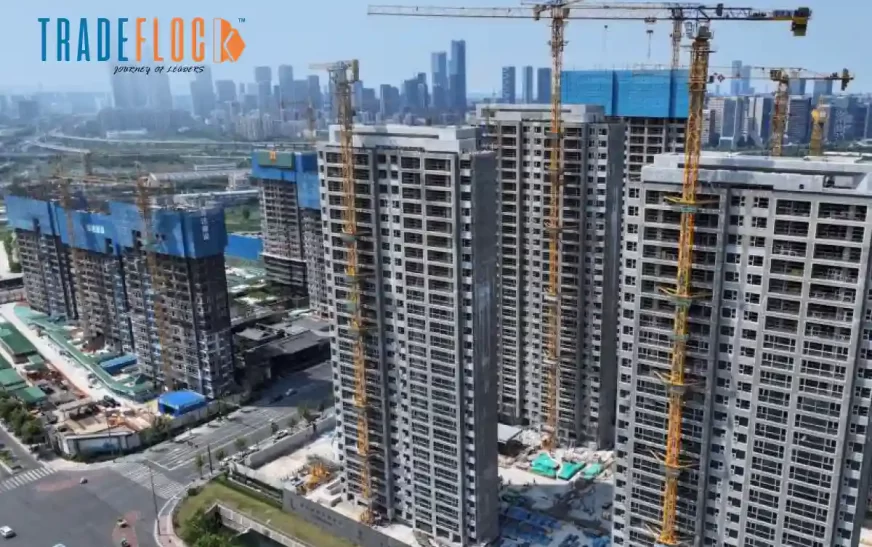
The property industry in China, which once led to a fast urbanisation of the country, is in its worst crisis in decades. With the large companies such as Evergrande and Country Garden having too much debt to handle, the impact has been observed in the financial markets, the supply chain, and popular opinion. The collapse will serve as a lesson to China and the emerging market economies of the consequences of unregulated growth, speculative funding, and an ambiguous government.
Evergrande: A Bust to Boom Story
Evergrande was the second-largest property developer in China, and it became a symbol of the Chinese building boom. The company was at its peak with assets worth more than 300 billion dollars and was in charge of thousands of projects in over 280 cities. Its rapid growth was financed by huge debt, with the company dependent on pre-sales of non-completed properties and shadow banking products to drive its growth.
But this model started to fall apart when Beijing introduced the policy of the Three Red Lines in 2020 to contain systemic financial risk. This policy brought the introduction of debt thresholds grounded on three parameters which are; liability-to-asset ratio, net gearing ratio and cash-to-short term debt ratio. Evergrande could not pass any of the three and lost its access to credit markets triggering a liquidity crisis that resulted in a historic default in 2021.
The consequences were instant and immense. Hundreds of projects were put on hold, suppliers went unpaid and millions of homebuyers who had pre-purchased apartments were left hanging. Trust in the company was lost and the stock price of the company dropped more than 90 percent.
Country Garden: A Crisis in Slow Motion
Country Garden, which was praised as the prudent Evergrande, soon went on the same path. With the housing market cooling down in China and the consumer confidence decreasing, sales slowed down and liquidity dried up. In 2023, the company defaulted on debt payments, only avoiding default by restructurings at the last minute.
Country Garden, unlike Evergrande, was more widely spread in the lower-tier cities in China, which were more prone to economic crises. Its failure further worsened the crisis in regions where real estate was the major economic booster.
Regulatory Response: Fallout and Building Trust
In response to the threat of a wider financial contagion, the Chinese government instituted a number of actions to stabilise the sector:
- Liquidity Support: Policymakers urged state-owned banks to lend money to distressed developers and offered special lending facilities to make sure that constructions were completed.
- Project Takeovers: State-owned companies were to take over and complete projects that had stalled and deliver the project to home buyers.
- Homebuyer Protections: Such steps as mortgage holidays and stimulus to buy new homes to revive the buyer interest and the unrest among the people.
- Developer Ratings and Watchlists: Regulators started rating developers in terms of financial soundness, an indicator of increased transparency and control.
Nevertheless, there remain obstacles. The mood in the market is still precarious and a large number of developers are still reeling under unsustainable debt and declining sales. The rapid recovery is also constrained by the oversupply in certain regions.
Implications for Emerging Markets
The fall of the Chinese property giants presents important lessons to other emerging markets that have rapidly developing real estate markets, like avoiding overdependence on real estate, restricting speculative financing, enhancing regulatory enforcement, completing the projects on time and encouraging sustainable urban planning
Investor Wariness and Capital Flows Reversion
There have also been consequences of the crisis on global capital flows. The Chinese property bonds and equities are increasingly becoming unattractive to international investors who are shifting the funds to more stable markets in Southeast Asia, India and parts of Africa.
BlackRock, UBS and other large institutional investors have marked down their Chinese property positions, and alternative assets managers are adjusting risk models to reflect political and regulatory uncertainty in future investments.
To global developers and financial institutions, the importance of strong due diligence, scenario planning, and geopolitical awareness has never been more evident.
The Turning Point of Global Real Estate Governance
Evergrande’s collapse, along with that of Country Garden and similar companies, marks a significant turning point not just in China, but also in how the world views the risk associated with real estate. It highlights the fragility of debt-driven development, the importance of foresight in regulation, and the significance of trust among citizens
The other thing emerging markets need to remember as they keep urbanizing and opening up to foreign capital is the lessons that are being learnt through the crisis in China. Real estate could serve as a pillar of development as long as it is based on transparency, financial prudence, and viable planning. The world is observing- and is learning.