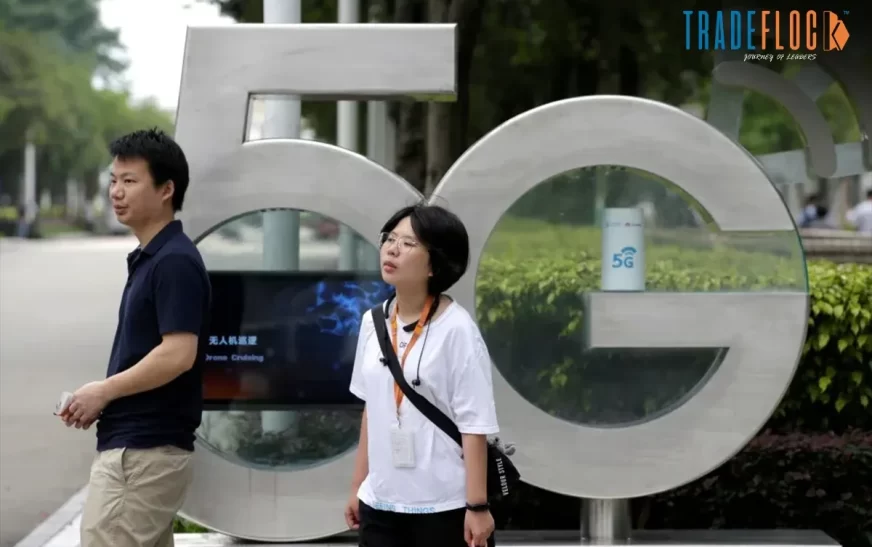
Asia remains the global leader in 5G standalone accessibility. China’s SA(Standalone) sample share was approximately 80.9% SA availability by Q4 2025, leading global rollouts, while Japan remained at 6.9%. India, Singapore, and South Korea are also rapidly accelerating and leading Asia’s 5G network.
China continues to expand its massive 5G infrastructure, with 5G-enabled devices being “SA by default” since early 2021. As a result, China leads Asia in 5G standalone availability, with more than 10 million subscribers using advanced 5G. More than 6,400 enterprise private networks are in operation, and 4.84 million 5G base stations are expected to be deployed by the end of 2025.
Other Asian countries aren’t far behind. India is projected to have a 48.4% SA share by late 2025, driven by Reliance Jio’s strategic decision to bypass the non-standalone architecture, placing it between China’s scale and more cautious approach, thereby accelerating local 5G capacity and innovation.
Japan is actively expanding its SA network. South Korea, an early adopter of 5G standalone, with KT offering only nationwide coverage, has progressed more conservatively in SA.
Singapore remains a key hub in the region for 5G deployment, alongside South Korea. Singapore, with a 38.9% SA share, delivered median download speeds of 462 Mbps in Q4 2025, positioning it among the highest-performing Asian markets outside South Korea and India. Moreover, Hong Kong achieved an 8.8% SA share in the same stretch, strengthening uneven adoption across leading regional hubs.
Also Read: Macquarie’s $8.3B Qube Deal Sends Shares Soaring
The Asia-Pacific regions continue to outpace Europe and the US in standalone. Across Asia and Oceania, 28 operators have launched 5G core networks. Global 5G core software spending is projected to grow at an 8.8% CAGR between 2025 and 2030, with EMEA leading at 16.7%, significantly outpacing North America at 5.5% and Asia & Oceania at 4.2%.