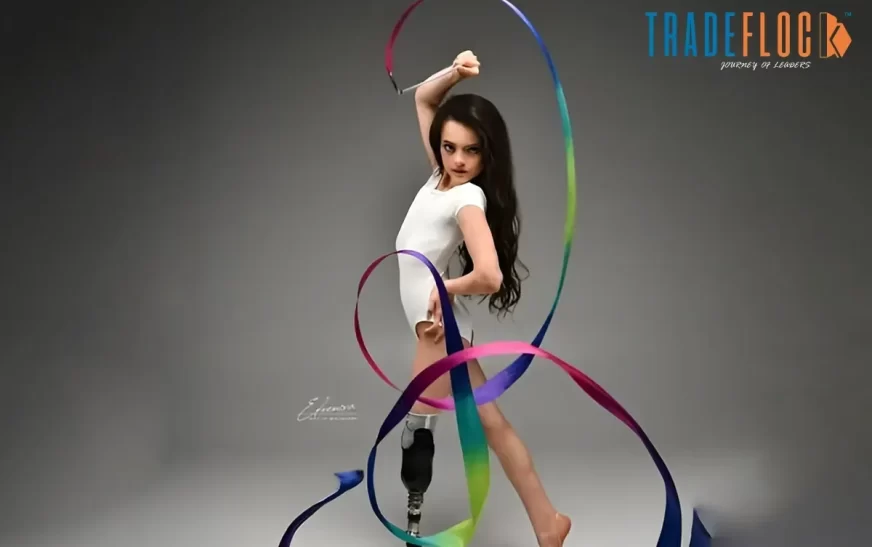
At Tokyo’s Children’s Education Laboratory on 31 July, Oleksandra “Sasha” Paskal performed before schoolchildren, athletes and journalists. The 10-year-old Ukrainian rhythmic gymnast had arrived at the fifth and final city of Dance of Freedom, a 15-day journey through Paris, New York, Rio de Janeiro, Nairobi and Tokyo. Five stops brought sharply different audiences into the same story.
The tour could have passed as another resilience story from a country at war. Its sporting significance runs deeper. Paskal remains a competitive rhythmic gymnast, and organisers used her routine to move Ukraine’s children into rooms where sport rarely appears: UNESCO, UNICEF events, Times Square and an education laboratory on the other side of the world.
The overlooked element is the tour’s deliberate international design. Her story has become part of Ukraine’s broader effort to keep the experiences of children affected by the war visible internationally. Dance of Freedom turned a gymnastics routine into a form of international witness, placing the experience of one Ukrainian child in five very different public settings.
Before the Tour
Paskal was six when a Russian missile struck Zatoka, a seaside village in Ukraine’s Odesa region, in May 2022. She and her mother, Mariia, had travelled there during the first months of Russia’s full-scale invasion. The blast left Sasha with a severe head injury and crushed her left leg beneath a concrete slab.
Doctors found no circulation in the limb. Sasha spent 15 days in intensive care, including a medically induced coma, before surgeons amputated her leg. Recovery meant prolonged rehabilitation, learning to walk with a prosthesis and eventually returning to the sport she had begun before the attack.
Rhythmic gymnastics gave the recovery a direction. Sasha returned to training and later competed alongside non-disabled children. She won medals in Ukraine, then earned recognition at an international tournament in Romania. President Volodymyr Zelenskyy and First Lady Olena Zelenska presented her with the Future of Ukraine state honour in 2025.
Her schedule makes it a sports story alongside its account of tragedy and demands a fuller reading. According to the United Nations, she trains for three to four hours a day, five days a week. Mariia Paskal has said the gym helped her daughter regain confidence in her prosthesis and stay connected to the life she knew before the strike.
The Work Of A Routine
Rhythmic gymnastics asks athletes to make balance look instinctive. It requires precision through turns, jumps and transitions. A prosthetic leg changes every calculation, especially in a discipline where a small loss of control can break the line of a performance.
Paskal’s return therefore carries a technical dimension that broad accounts of courage can flatten. She has had to rebuild movement inside a sport that demands symmetry and flow. Training does not erase the injury. It creates a place where mastery can grow around it.
Dance of Freedom widened that process into public diplomacy. Paris opened the route with a UNESCO appearance. New York placed Paskal in Times Square. Rio included a meeting with Brazil’s national artistic gymnastics team, while Nairobi connected her performance to UNICEF’s 80th-anniversary events. Tokyo completed the circuit.
The Rinat Akhmetov Foundation runs the project with FC Shakhtar Donetsk. Shakhtar’s involvement adds another layer to the story. Russia’s war forced the football club from Donetsk in 2014, and its teams have since lived with the logistics of displacement. Paskal’s journey joins a longer Ukrainian sporting effort to keep competing, training and being seen.
What Sport Carries
The locations did more than provide a backdrop. Each one changed the audience around the same young gymnast. UNESCO framed her routine beside education and culture. Times Square brought it into a commercial crossroads. UNICEF linked it to the rights and safety of children. Tokyo put the final performance before young people who may remember the image longer than any speech.
Paskal did not travel as a visiting dignitary. She travelled as an athlete with a demanding schedule, a discipline and a competitive record. That distinction gives Dance of Freedom its force. War often turns injured children into evidence of suffering. Gymnastics lets Sasha appear as someone still building a future through repetition, fatigue and skill.
Tokyo supplied the most revealing detail. The final stop took place in an education laboratory before schoolchildren, outside the ritual of a medal ceremony. Sasha’s balance on one prosthetic leg became a lesson for the children in the room: a future survives when young people still have space to practise what they love.