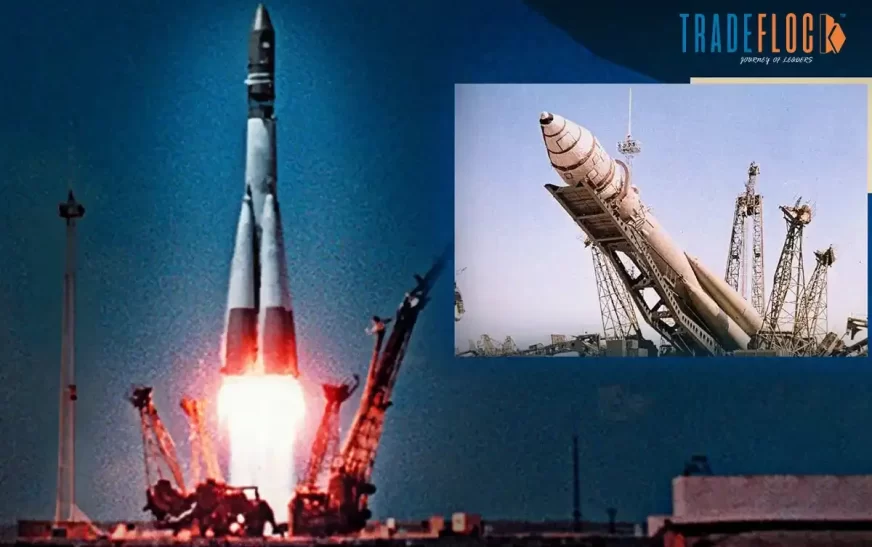
It was the morning of August 11, 1962, and radios all across the Soviet Union were buzzing with urgent updates. At the Baikonur Cosmodrome, out in the scorching Kazakh steppe, a shiny steel capsule sat on top of an R-7 rocket, gleaming in the summer sun. At exactly 08:24 Moscow time, with a deafening roar, Vostok 3 blasted off into space, carrying cosmonaut Andriyan Nikolayev with it. The world watched, holding its breath, as another major moment in space history unfolded — once again, courtesy of the Soviets.
A Cold War Race Playing Out in Orbit
By 1962, the Space Race between the US and the Soviet Union wasn’t just about prestige anymore — it had become a symbol of the bigger ideological rivalry between the two superpowers. The Soviets, riding high off the success of Sputnik in 1957 and Yuri Gagarin’s historic orbit aboard Vostok 1 in 1961, had captured the world’s attention — and in some places, real concern. But the pressure from the American side was building too. NASA’s Project Mercury was making progress, and just a few months earlier, in February 1962, John Glenn had become the first American to orbit Earth.
It was in this atmosphere of competition and global tension that Vostok 3 was born. The mission wasn’t just about sending a man into space — it was about pushing the limits of how long a human could survive in orbit, and pulling off something genuinely unprecedented: having two spacecraft in orbit at the same time.
The People Behind the Mission
Vostok 3’s success came from years of work between government agencies, scientists, and some seriously brave individuals. The mission was led by the Soviet space program under Sergei Korolev, the chief designer behind nearly every major Soviet space achievement. Interestingly, his identity was kept a closely guarded secret during his lifetime — but his engineering genius was really the driving force behind it all.
Andriyan Nikolayev, the cosmonaut chosen to pilot Vostok 3, came from central Russia and was known for staying calm and composed under pressure. He was selected after a gruelling process that tested his physical endurance, mental toughness, and technical skill. As a trained air force officer, he brought exactly the kind of discipline the mission needed.
The flight was supported by ground control teams working out of several locations, including the highly secretive Baikonur Cosmodrome — the launch site for all Soviet crewed space missions. Just a day after Vostok 3 launched, Vostok 4 followed, piloted by cosmonaut Pavel Popovich. For the first time ever, two human spaceflights were happening in orbit at the same time — and the two crews were even able to communicate with each other by radio.
Pushing the Limits of Human Endurance
Vostok 3 stayed in orbit for almost four days, completing 64 trips around the Earth before landing safely on August 15, 1962. During the flight, Nikolayev ran biological experiments, monitored the spacecraft’s systems, and kept detailed notes on how his body and mind were holding up. The mission proved that a person could survive — and actually function well — in zero gravity for an extended period of time.
The mission also showed that coordinating two spacecraft in orbit at once was possible. The two capsules never actually docked together, but at one point they came within just five kilometres of each other — a big step toward the kind of orbital rendezvous techniques that would later become essential in the Soyuz and Apollo programs.
A Mission With Global Ripple Effects
The impact of Vostok 3’s success went well beyond just science. On the world stage, it reinforced the Soviet Union’s dominance in early space exploration. For the USSR, these achievements weren’t just scientific wins — they were political statements too, meant to show off Soviet technological power during the height of the Cold War.
Across Europe, Asia, and Africa — especially in countries that had recently gained independence — the Soviet Union’s success in space was seen as proof that emerging nations could challenge Western dominance through science and state-driven innovation. For a lot of people, it felt like the beginning of a new world order, one where technological leadership wasn’t just something the capitalist West could claim.
In the United States, the twin Vostok 3 and Vostok 4 missions actually pushed the government to invest even more in space exploration. Within months, NASA’s funding increased, and projects that would eventually lead to the Apollo program were fast-tracked. President Kennedy, who had already promised to put an American on the Moon before the decade was out, pointed directly to Soviet progress in space as a reason to accelerate US efforts.
Back home, the Soviet Union used the Vostok 3 mission as a powerful propaganda tool. Posters featuring Nikolayev and Popovich went up across cities, and their return home was celebrated with parades and official honours. The cosmonauts became national heroes — inspiring an entire generation to pursue science, engineering, and aviation.