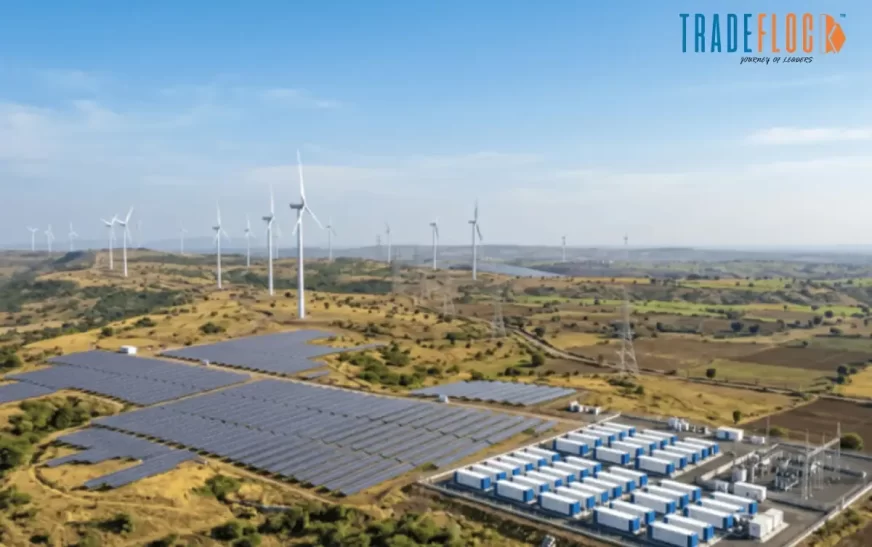
Asia’s energy-hungry boom is forcing a rethink: decarbonisation isn’t the brake on growth anymore. It’s the throttle.
For the last decade, corporate sustainability in Asia has usually been a tick-in-the-box activity: filing the right disclosures and achieving modest procurement targets for renewables, only to satisfy investors and regulators. However, that era is bygone now. Asia’s data centre market is on track to roughly double in value, from $13.71 billion in 2024 to $30.47 billion in 2030, and the capital chasing the investment is also demanding a climate-related addendum.
No organisation illustrates this shift more starkly than the Adani Group does. In February, the ports-to-cement Indian conglomerate committed $100 billion through 2035 to build AI data centres powered by renewable energy. The move will galvanise $150 billion in ancillary investment that will increase the capacity of AdaniConneX, its data centre service provider, from its existing capacity to 5 gigawatts.
In June, Reliance Industries said that it would build its first data centre for Facebook parent Meta Platforms in Gujarat. The project is part of the $110 billion commitment that the oil-to-telecom conglomerate has made to invest in data centres, renewable energy, and other infrastructure projects to achieve its net-zero carbon goal by 2035.
The Energy-Edge Calculation
The math behind the shift is straightforward. Power consumption by data centres in the ASEAN region is expected to rise from 9 terawatt-hours in 2024 to 68 terawatt-hours in 2026. Malaysia is leading the region’s pipeline, with 2.4 gigawatts under construction, much of it clustered around Johor, some 70 kilometres north of Singapore.
However, cooling the data centres in this tropical climate compounds the problem. According to the IEA, regional electricity demand is expected to grow 4% annually through 2035, with air conditioning alone accounting for 30% of electricity demand. Consequently, operators who are unable to secure a low-carbon power supply at scale will end up paying for dirtier electricity, losing access to green financing, and falling behind on the ESG scorecards that institutional investors use to evaluate infrastructure deals.
“Energy-edge” thinking, where computing facilities are located in proximity to clean-energy power supplies, grid capacity, and cooling facilities, has become a genuine cost and competitiveness layer.
Japan’s Mismatch Problem
Japan offers a cautionary tale when “energy-edge” is not considered. Roughly 90% of Japan’s data centres are located in the Tokyo-Osaka corridor, while the country’s biggest renewable and nuclear facilities are located in Kyushu and Hokkaido, hundreds of kilometres away. Mitsubishi Research Institute’s Naoki Nishikado has dubbed this a structural geographic mismatch between where digital infrastructure is built and where clean energy is actually generated.
Tokyo’s response to this was the “Watt-Bit Collaboration”, launched by the Ishida cabinet in 2025 to bring together the trade ministry, the communications ministry, academics, and industry to coordinate siting decisions before the mismatch hardens into stranded assets on one side and unmet demand on the other. The lesson for the rest of Asia is that climate alignment is as much a grid-planning and permitting problem as a technological one, and governments that solve it early gain a durable investment advantage.
Manufacturing’s Quieter Transformation
This same logic applies to manufacturing floors. Asia Pacific’s sustainable manufacturing equipment market was valued at $96 billion in 2024, according to market research firm Global Market Insights, and is expected to grow faster than any other region. China is dominating the supply side, with Chinese companies having invested $625 billion in 2024, according to BloombergNEF. This represents 31% of the global total, and Chinese EV and battery manufacturers have committed roughly $80 billion over five years.
For emerging economies, it is jobs, technology transfer, and a foothold in supply chains that are being reorganised around lower-carbon inputs. Indonesia’s position as the world’s largest nickel producer, feeding battery manufacturing rather than simply exporting ore, is the clearest example of a country converting a resource endowment into a manufacturing upgrade via the energy transition.
What Discipline Still Requires
No amount of investment by countries and the potential they offer can erase the tension at the heart of this boom. Grid emission factors across Asia’s data centre hotspots are being heavily outpaced by demand. Grid intensity in Singapore is projected to fall by under 5% by 2030. Indonesia’s already carbon-heavy Jawa-Madura-Bali grid, the largest and most critical electricity network in the country, is barely improving.
Companies layering AI ambitions onto fossil-heavy grids and calling it “green” risk a credibility gap that institutional capital will eventually recognise. The leaders pulling ahead are the ones treating renewable procurement, storage and efficient cooling as core infrastructure decisions rather than offsets purchased after investments in data centres. In a region where energy demand is the binding constraint on growth itself, that distinction is no longer a sustainability talking point but the difference between a project that scales and one that doesn’t.