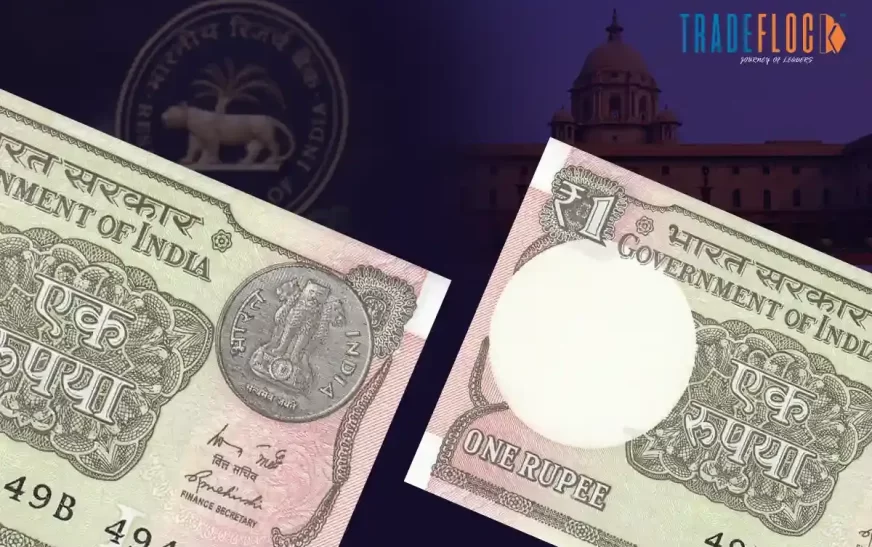
Generally, people assume that all currency notes in India are issued by the Reserve Bank of India (RBI). A one-rupee note is not just your typical Indian currency note issued by the Government of India. Unlike your usual notes, such as ₹10, ₹20, or ₹50, which bear the RBI Governor’s signature, the one-rupee note carries the Finance Secretary’s signature.
If you have been wondering, “Why One Rupee Note Is Issued by Finance Ministry?”, you are not alone.
According to the Reserve Bank of India Act, 1934 (Section 22), the RBI issues banknotes of all denominations, including the infamous one-rupee note. Further strengthening this, the Coinage Act, 201. Further to seal the deal, the Coinage Act, 2011, treats the “Indian one-rupee note” as a coin in paper. This is the core reason “Why One Rupee Note Is Issued by Finance Ministry, just like coins.
This categorises the ₹1 note into an exceptional category. You will be surprised to know that this question is commonly asked in exams, interviews, and general knowledge discussions.
Curious to know more? Through this informational piece, you will get a clear and complete explanation of the legal, historical, and practical reasons behind why the ₹1 note is different from other currency notes in India.
A Quick Guide to the Historical Overview of 1 Rupee Notes
Originally, the one rupee coin was introduced under British rule in the year 1917, to conserve metal in World War I. It was later discontinued in 1926. The one rupee coin was revived in 1940, and continued post -independence with government issuance.
After continuing for a certain period, their production stopped in 1994, but this time there was reasoning behind it. They had high printing costs but were later reintroduced in 2015, bearing the signature of Rajiv Mehrishi, then Finance Secretary. This historical journey also reflects “ Why One Rupee Note Is Issued by Finance Ministry.”
Fun Fact: When it comes to “Design-front”, the ₹1 note lacked the infamous RBI’s promise clause and instead reads “भारत सरकार”, which translates to “Government of India”.
Over the decades, the note has seen many ups and downs. It has been issued, withdrawn and reintroduced multiple times depending upon the time, economic conditions and cost considerations. Though, irrespective of the discontinuation, its legal status as currency has never been abolished.
RBI Act Explained in Detail: Legal & Constitutional Framework
Now, it might be clear that the RBI doesn’t launch the ₹1 note, but there is a unique system that they follow. This generally comes under Section 22 of the Reserve Bank of India Act, 1934. This gives RBI the sole authority to issue all banknotes in India, with the exception of the one-rupee note, as you already know.
The distinctive feature of the One-Rupee Note is generally the reason behind it. RBI Act Explained in Detail: Legal & Constitutional Framework. It comes under the provisions of the Indian Coinage Act and related legal Basis. This is a major reason, “ Why One Rupee Note Is Issued by Finance Ministry.”
The note carries the Finance Secretary’s signature, from the government of India rather than the Central Bank Governor. This distinctive arrangement reflects the fact that the RBI is constitutionally responsible for issuing currency notes. While the ₹1 note in India is considered part of the government’s responsibility, similar to the coin, the very reason they fall under the Ministry of Finance. This is why:
- ₹2 and above notes are issued by the RBI
- ₹1 notes are issued by the Government of India
Two Major Distinctions About One Rupee Note
The first major distinction is that the Indian ₹1 note bears the Finance Secretary’s signature, whereas the other notes usually bear the RBI Governor’s signature. This might look like a minute difference, but this is what makes the ₹1 note unique in India’s currency system
Another difference that stands out is the absence of the “I promise to pay the bearer” clause on every ₹1 note. This clause generally comes with RBI-issued notes and is directly backed by the Government of India. These differences further explain “Why One Rupee Note Is Issued by Finance Ministry”
A Quick Breakdown of ₹1 Note (A Simple Read)
| Feature | ₹1 Note | Other Notes |
| Issued by | Ministry of Finance | Reserve Bank of India |
| Signature | Finance Secretary | RBI Governor |
| Legal Status | Treated like a coin | Banknote |
| Promise Clause | Not present | Present |
The Major Role of ₹1 Note in the Banking System
In the typical banking setup, the one-rupee note has a very limited role due to its low purchasing power and due to its zero to negligible circulation, banks such as State Bank of India, Punjab National Bank, Bank of Baroda, Canara Bank and the Union Bank of India rarely use 1 rupee cash for routine cash management or high-volume transactions.
However, it is part of the valid legal tender, and occasionally it might appear in deposits, withdrawals or accounting balances. This continued validity supports,” Why One Rupee Note Is Issued by Finance Ministry.”
Why is the ₹1 Note Still Relevant Today?
Even though coins have largely replaced low-denomination ₹1 transactions for everyday use, the government still prints them occasionally. There are several reasons,” Why One Rupee Note Is Issued by Finance Ministry” and why this note remains relevant in the Indian Economy:
- To maintain the legal structure of India’s currency system
- Symbolises India’s monetary continuity and sovereignty
- It generally represents the base unit of Indian currency
- Holds a unique historical and symbolic context, in the rich indian currency structure
- Occasionally used for special or limited money circulation
In brief, though ₹1 notes are rarely used in daily transactions in the present landscape. In reality, they are still printed to reflect the policy intent to preserve this symbolic element of the currency system. This is another clear indication, “Why One Rupee Note Is Issued by Finance Ministry.”
Must-Know Misconceptions About ₹1 Note
One-rupee notes come with their own set of myths that often confuse people:
- Myth: ₹1 note is issued by the RBI, which is untrue
Fact: The note is issued by the Ministry of Finance - Myth: One-rupee note is not legal tender
Fact: This is fully legal and valid all across India - Myth: ₹1 note is discontinued, but still occasionally used
Fact: It is still printed occasionally, but in limited editions
So, to Sum It Up
The reason why one rupee note is issued by Finance Ministry completely depends on the legal provisions and historical practices. Unlike the other currency notes, the ₹1 note is treated as a coin and hence falls under the authority of the Government of India. Nevertheless, the coexistence of both reflects the layered nature of India’s currency system, where historical instruments coexist with modern monetary practices.
With this informative piece, you might have understood that the unique status, different signature, and absence of the promise clause make it stand out in India’s currency system. Even though it is occasionally used today and will continue to hold legal and symbolic importance.
Understanding Why One Rupee Note Is Issed by Finance Ministry not only clears a common doubt but also gives you deeper insight into how India’s financial system works.
Frequently Asked Questions
1. Why does the ₹1 note have the Finance Secretary’s signature?
The one rupee note is issued by the Finance Ministry, not the RBI. Here, the Finance Secretary represents the Government of India in financial matters.
2. Is ₹1 note still in circulation?
Yes, the one-rupee note is still used in everyday use, usually as legal tender.
3. Why doesn’t RBI issue ₹1 note?
The RBI Act of 1934 specifically excludes the one-rupee note from the RBI’s authority. It is managed by the government instead.
4. Is the ₹1 note equal to a coin legally?
Yes, the typical one-rupee note is treated as a coin in paper form, which is why it falls under government issuance.